Product Resource Page

Polyureas

What You Need To Know

Product Overview


SpecChem’s Polyureas are designed to protect concrete control joints and support long-term floor performance in demanding environments. These fast-curing, durable joint filler solutions help reduce joint edge damage caused by forklifts, pallet jacks, carts, and daily traffic. Whether you’re working on warehouse floors, distribution centers, manufacturing facilities, retail spaces, or polished concrete projects, SpecChem polyureas help contractors and specifiers reduce risk by supporting joint stability, limiting deterioration, and improving the finished appearance of concrete floors.

  • Fast Return to Service: Quick-curing formulas help reduce downtime on active projects.
  • Joint Edge Protection: Supports control joint edges and helps reduce spalling, chipping, and breakdown.
  • Traffic Resistance: Designed for floors exposed to forklifts, pallet jacks, carts, and heavy use.
  • Durable Floor Support: Helps protect joints in commercial, industrial, and polished concrete applications.
  • Cleaner Finished Appearance: Creates a smooth, professional-looking joint finish.
  • Reduced Maintenance: Helps limit joint deterioration that can lead to costly repairs and downtime.

Explore The Lineup

Product Solutions

Answers Made Simple

Frequently Asked Questions


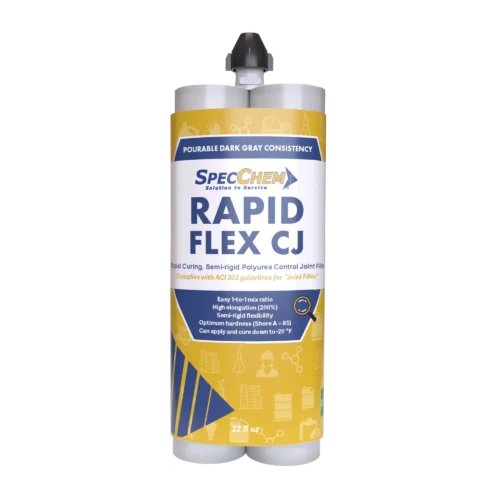
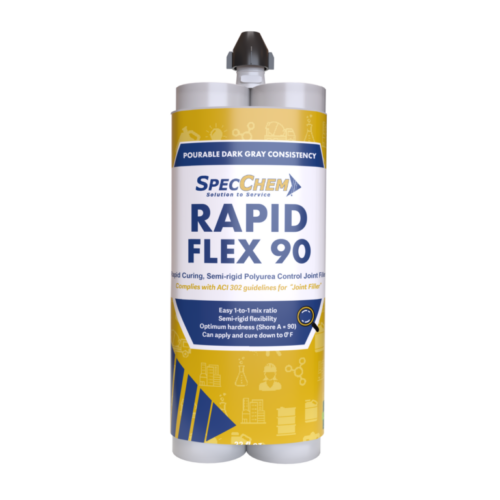
A polyurea joint filler is a rapid-curing, semi-rigid material used to fill control and construction joints in industrial and commercial concrete floors. Rapid Flex CJ and Rapid Flex 90 support joint edges, transfer wheel loads, and help reduce spalling caused by forklifts, carts, and other hard-wheeled traffic.

Semi-rigid polyureas such as Rapid Flex CJ and Rapid Flex 90 are designed primarily to support joint edges while accommodating moderate slab movement. Flexible sealants are intended for expansion or isolation joints that experience greater movement but generally do not provide the same load-bearing support for hard-wheeled traffic.

Polyurea fillers cure and can be shaved much faster than traditional epoxy fillers, helping reduce downtime. Rapid Flex CJ and Rapid Flex 90 also provide higher elongation and remain semi-rigid without welding slabs together or becoming brittle. Epoxy fillers may provide greater rigidity but generally require a longer curing period before finishing.

Choose Rapid Flex CJ where greater flexibility is desired. It has a Shore A hardness of 85 and approximately 200% elongation. Choose Rapid Flex 90 for heavier hard-wheeled traffic and greater joint-edge support; it has a Shore A hardness of 90 with approximately 100% elongation. Both are UV-resistant and designed for industrial floor joints.

Rapid Flex products cure rapidly and can generally be shaved shortly after placement, depending on temperature and jobsite conditions. Rapid Flex CJ is commonly allowed to cure for about one hour before shaving, although SpecChem installation guidance notes that shaving may be possible sooner under suitable conditions. The material should be slightly overfilled and then cut flush with the floor.

Yes. Rapid Flex CJ and Rapid Flex 90 can be applied and cured in temperatures as low as approximately -20°F, making them suitable for freezers, cold-storage facilities, and other low-temperature applications. The components should still be conditioned to at least 50°F before mixing to maintain proper flow and set time.

Joints must be clean, dry, and free of dust, water, curing compounds, densifiers, sealers, oil, and other contaminants. SpecChem recommends cleaning the joint faces with a dry-cut abrasive blade, vacuuming thoroughly, and using oil-free compressed air when needed. Proper preparation helps Rapid Flex CJ and Rapid Flex 90 bond correctly and cure without defects.

Saw-cut control joints should generally be filled full depth. In joints deeper than two inches, Rapid Flex CJ should be installed to a minimum depth of two inches, while Rapid Flex 90 requires at least one inch of filler. Compressible backer rod should not be used to reduce the depth of saw-cut control joints. Always follow the product-specific detail.

Yes. Rapid Flex CJ and Rapid Flex 90 can be overfilled and shaved flush to create a smooth transition across polished concrete floors. They are UV-resistant and available in architectural colors for projects where appearance matters. Spec CJ Guard can be applied around the joint before filling to help prevent staining from overfill and simplify cleanup.

Joint filling should generally be delayed as long as the construction schedule permits so most drying shrinkage can occur first. SpecChem cites ACI guidance recommending installation approximately 60 to 90 days after slab placement when practical. Filling too early may lead to separation as the slab continues to shrink, although the void can later be cleaned and refilled.

Learn by Watching

Product Videos


Articles & Blog Posts

SpecPros Content


Subscribe to SpecPros

Get our industry-leading expert content right in your inbox